
Lead differently. Without becoming someone else.

Growing into a bigger role feels awkward long before it feels natural. I'll help you shorten that stretch, starting with something you can try this week.
“She was direct, empathetic, and challenged me in exactly the right ways.”
— Chris Platika, Chief Innovation Officer

You were promoted to a senior role because you excelled at the last one. Your team grew, your title changed, and people who used to be your peers started waiting on you to decide.
The things that always worked started landing differently than you meant them. You're being helpful; it arrives as critical. You're being efficient; it arrives as dismissive. The feedback contradicts itself — you're not decisive enough, and you're also not consultative enough — and both are somehow accurate.
You can feel that something's off. You just can't see what it is from where you're standing. None of us can.
To overcome the wobbles, you try something new.
You walk into your 1:1 with the CEO, heart pounding. Acting on her feedback, you share your recommendation up front instead of walking through how you got there. It comes out shorter and flatter than you meant it, and you replay the conversation for the rest of the afternoon.
Was that better? Did that even sound like me?
It was better. It just didn't feel like it yet.
That's what growth feels like from the inside, and coaching can help you through it.

Wobbling on your growth edge?
“I always felt Gina was on my side — which was very much needed at a time when I felt isolated and alone.”
— Caitlin, Executive Director, Higher Education
Why work with me
Someone outside your orbit, who has been in your shoes
Years ago, a dean I admired was invested enough in my leadership to tell me something no one else had the courage to say:
"You want to be liked too much. You don't need people to like you. You need people to respect you."
It stung. It was also the most honest feedback I’d received in years. He could see what I couldn’t see, and he said it plainly and kindly at the same time.
As a coach, I embody that clear, kind, outside perspective for my clients. I believe every leader has the capacity to be brilliant. At key leadership inflection points, we need someone outside our orbit to name what's in our way without flinching and believe in us until we can do it ourselves.
I've spent more than twenty years being a leader and developing them:
I've held the seat. As Associate Dean at Dartmouth's Tuck School of Business, I ran strategy and operations for a team of more than fifty. I once sat on a decision about a person for months, hoping it would resolve itself. It didn't.
I've built the curriculum. As Head of Leadership Development at Boston Beer and Senior Director of Organizational Development at Strava, I designed leadership programs for hundreds of managers and worked alongside thinkers including Frances Frei and Amy Edmondson on leadership design and C-suite succession.
I've done the research. I hold an EdD in Leadership and Learning in Organizations from Vanderbilt, where my doctoral capstone examined how organizational culture shapes decision-making, and an MBA from Tuck. I've fine-tuned my coaching skills at the Co-Active Training Institute and in Tara Mohr's The Coaching Way.
When we find the thing that's getting in your way, I've often seen it before, as a leader and a learner.
Clients include:
-
![Lead with Gina client logo Novagard]()
Novagard
An innovator and manufacturer of silicone sealants, coatings, lubricants, and foams for the electronics, transportation/automotive, manufacturing, construction, medical, and military markets.
-
![Lead with Gina client Dartmouth College logo]()
Dartmouth College
One of the world's greatest academic institutions and a member of the Ivy League.
-
![Lead with Gina client Fitch Group]()
Fitch Group
A global leader in credit ratings and research. Their analysts cover 5,000 financial institutions, 2,850 corporates and 160 sovereigns and supranationals.
-
![Lead with Gina client MidPen Housing]()
MidPen Housing
A leading nonprofit organization that creates and manages affordable homes across Northern California.
-
![Lead with Gina client logo Enstructure]()
Enstructure
A terminals and logistics infrastructure company in the U.S. offering decades of experience in supply chain solutions.
-
![Lead with Gina client logo InStride Health]()
InStride Health
A clinician-founded and outcome-driven specialty care provider supporting children and young adults with anxiety, OCD, and related disorders.
-
![Lead with Gina client First Bank of the Lake]()
First Bank of the Lake
One of the Top SBA Lenders in the nation.
-
![Lead with Gina client Adeptia logo]()
Adeptia
An intelligent ETL platform purpose-built for complex enteprise data automation in regulated industries.
-
![Lead with Gina client Impax Asset Management]()
Impax Asset Management
One of the largest specialist investors focused on the transition to a more sustainable economy.


“Gina is so easy to talk to and she builds trust very easily. Working with a leadership coach can often times bring up some hard truths and tough conversations so having that mutual respect and trust was crucial to finding success for me.”
— Independent consultant, former head of marketing
How we will work together

Ground
We begin with an open conversation about what's working, where it's breaking down, and what "great" would look like six months from now. If your organization is sponsoring the work, I talk with your manager too, so we're all on the same page.
When it's useful, we add a Leadership Circle Profile 360, so you're working from a full picture rather than one-off comments that have been rattling around your head.
From there, we'll agree on two or three things to work on together. They stay concrete enough to practice in the meetings on your calendar this week: putting your perspective on the table when the conversation has already tilted the other way, giving hard feedback that stays useful, holding a decision when the room wants you to soften it.

Practice
Most engagements work best with a session 2 -3 times/month. We can meet more frequently at the start or along the way if you need additional support.
Each session, we work on what's actually in front of you — the conversation you're dreading, the meeting that went sideways, the decision you keep circling. We work on your inner critic, too, the voice that talks you out of the thing you'd already decided to do.
Every session ends with something to practice: a real conversation to try, something to read, something to reflect on. That practice becomes the fuel for our next session.
Between sessions, you have me on Voxer — a walkie-talkie style app for quick voice and text notes, so you have a direct line to me without scheduling anything. When something happens Wednesday at 4pm, we can work on it in real-time, while you remember how it felt.

Stretch
Once your new approach feels steady in your daily rhythms, we focus on your growth edge — attempting the thing you wouldn't have been ready to broach in month one.
If your company is sponsoring, we close with a check-in with your manager to celebrate and share your growth and development with the people who work most closely with you on a daily basis.
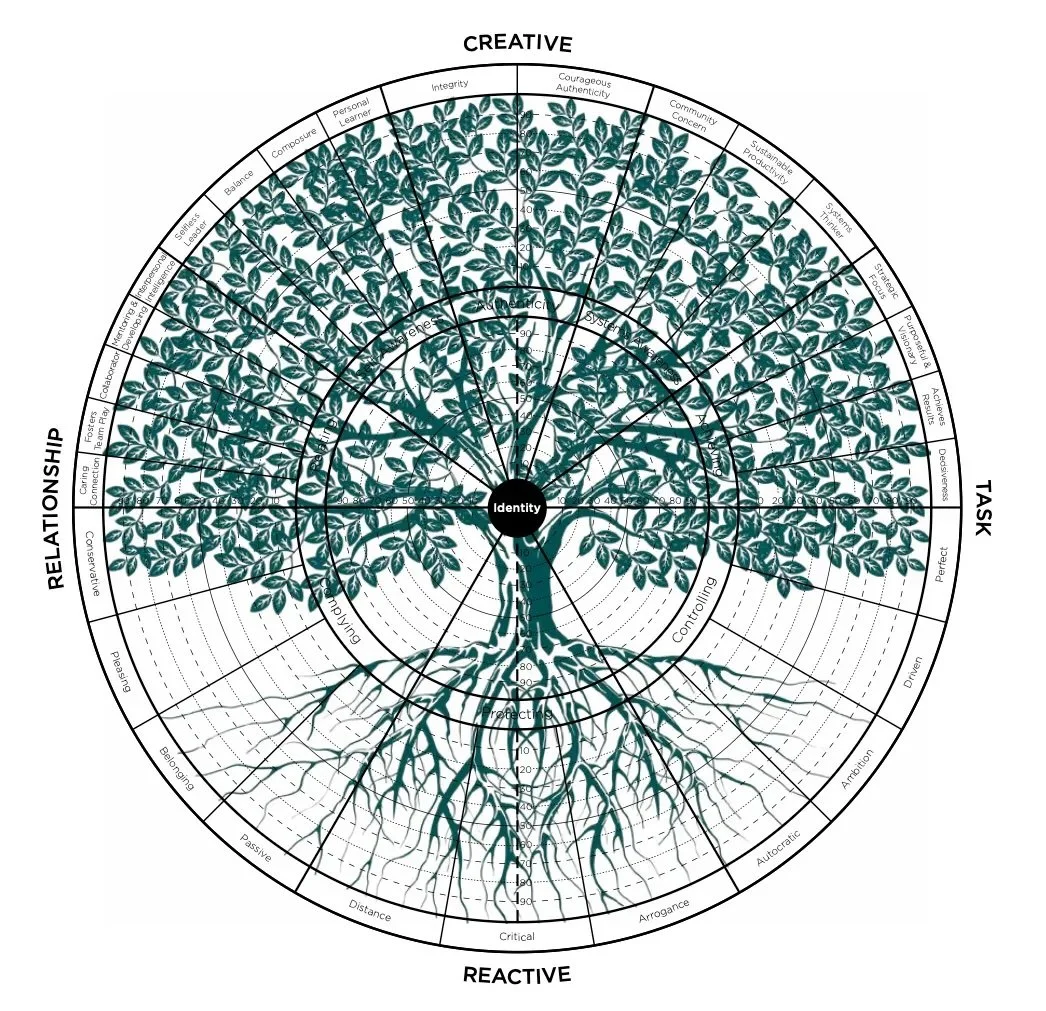
The Leadership Circle Profile 360
Most feedback a senior leader gets is vague, secondhand, or arrives too late to use. The Leadership Circle Profile gathers structured, confidential input from your peers, your directs, and your manager, and turns it into one picture of how you're actually experienced.
It measures two things at once: the creative competencies behind effective, relational leadership, and the reactive tendencies — the protective patterns that quietly limit you under pressure. Seeing both together is what makes it worth doing. Most leaders can describe their strengths. The reactive patterns are the ones nobody has ever named out loud for them.
We spend ninety minutes on the debrief: what shaped you as a leader, where the profile confirms what you suspected, where it surprises you, and which two or three things are worth working on. That becomes the baseline we measure against when we close.
I'm a certified Leadership Circle Profile practitioner. Learn more here.
Coaching case study
A senior technical executive at a fast-growing company
The challenge
His executive team was changing fast and his workforce had gone global — more perspectives, more communication styles, more competing needs. He was a formidable technical leader, and the rooms he was in now wanted something different from him.
He knew his approach had to change. What he couldn't do was see precisely what to change.
What we did
Before we started, I talked with him, his CEO, and his team, and we ran a Leadership Circle 360. He wanted the fullest possible picture of how he was coming across. That gave us a short list of specific things to work on.
We met weekly for three months, with Voxer between sessions to work real moments as they happened. Then twice monthly for three more, as the new habits set. I checked in with his CEO at the start, midway, and at the close.
The result
"The most impactful shift was learning to pause before responding, to listen with genuine empathy rather than reacting. Gina helped me understand that adapting my leadership style wasn't a sign of weakness, but a skill." — My client
Before our engagement ended, he successfully moved into a broader executive role.
From his sponsoring CEO:
"He's made significant improvements on becoming a better exec... I think it was totally a great investment."
Finding the right fit
This works best for you if:
Your scope recently grew, or is about to, and your instincts haven't caught up.
You're performing well and can feel the gap between where you are and where you're headed.
You're willing to look honestly at what isn't working, including in yourself.
You're eager to try new approaches between sessions.

This isn't the right fit if:
Someone told you to get a coach and you don't believe you need one. Coaching only works when you want it.
Coaching is a defensive step before an exit. If coaching is positioned as a last gasp or Hail Mary before a forced exit, I am not the right coach for the situation.
You'd rather not look inward. Coaching requires a willingness to unpack the things that feel hard. I'll make that as safe and welcoming as possible, but I can't do the reflecting for you.
You might be wondering (FAQ)
-
I hear you. And it's worth noticing that "no time" is frequently a symptom of the thing we'd be working on — the delegation that hasn't happened, the conflict you're routing around, the meetings you're sitting in because nobody's clear on who decides.
Practically: two hours a month, plus voice notes that fit in the gaps of your day. Most of the actual work happens in meetings you're already in.
-
Usually it's the reverse. Leaders get coaching because their organizations have decided to invest in them.
Think about elite athletes. Nobody at the top of any sport works without a coach, and nobody reads that as evidence they're failing. The coach exists because performance at that level is too consequential to leave to self-correction.
-
Engagements are priced by scope — length, cadence, whether we include a Leadership Circle 360 and manager check-ins — I'll give you a number once we've talked about what you actually need.
It's a meaningful investment. If the money is genuinely out of reach right now, tell me. Sometimes there's a version that works, and sometimes the honest answer is "not this year." What doesn't work is coaching someone who isn't ready to put the time and energy in. That's a waste of your money and both of our time.
-
I've found that many companies are willing to invest in their top talent, and it's always worth asking. Here's language you're welcome to borrow:
I'd like to invest in coaching this year. My scope has grown and I want to close the gap between how I'm leading now and what the role needs. I've found a coach who spent twenty years building leaders inside operating companies before she started coaching. She begins by gathering feedback from you and my team, we agree on two or three specific things to work on, and she checks in with you at the start and the end so we can measure progress against what you're seeing. Engagements run three to six months. Can we talk about a budget for it?
If it's useful, I'm happy to join a short call with your manager before anyone commits.
-
I'm not a therapist. If something surfaces in our work that belongs in therapy, I'll say so, and I'll help you find the right person.
Coaching looks forward. We start with how you're leading now and work toward what you want to be able to do next. Fear, confidence, and the stories you tell yourself will come up, because they show up in how you lead. And we always land somewhere concrete: what you'll do differently in Thursday's meeting.
-
We define what "great" looks like in the first conversation, with your manager in the room if your organization is sponsoring. From there we work against specific behaviors. A Leadership Circle 360 can provide a baseline, and the closing check-in with your manager measures against it.
You'll likely notice a change before that in situations that used to trigger fear or stress, and now feel smooth and steady.
-
The first conversation is a conversation. If either of us doesn't feel like it's a fit, it's important we work that out early. I have a strong network of talented coaches, and I'd be glad to point you toward someone better suited to what you need.
You’re ready to meet the moment.
You’re aware of the gap, or you have a nagging feeling that the way you're leading right now is costing you more than it should.
You don't have to sort it out from the inside by yourself.
Connect with me so we can talk through what's going on, and we'll figure out whether I'm the right person to help.